



Most home addition projects take months of back-and-forth with architects, permit offices, and general contractors before a single board gets nailed. This Xenia homeowner experienced a different process entirely — CPM ROOF handled the design drawings, managed the inspections, and built a complete three-room addition from the ground up in thirty days, keeping the entire project under $90,000. For a family that has trusted CPM with over $200,000 in work across ten years, this addition was simply the latest chapter in a long-running relationship built on results that consistently exceed expectations.
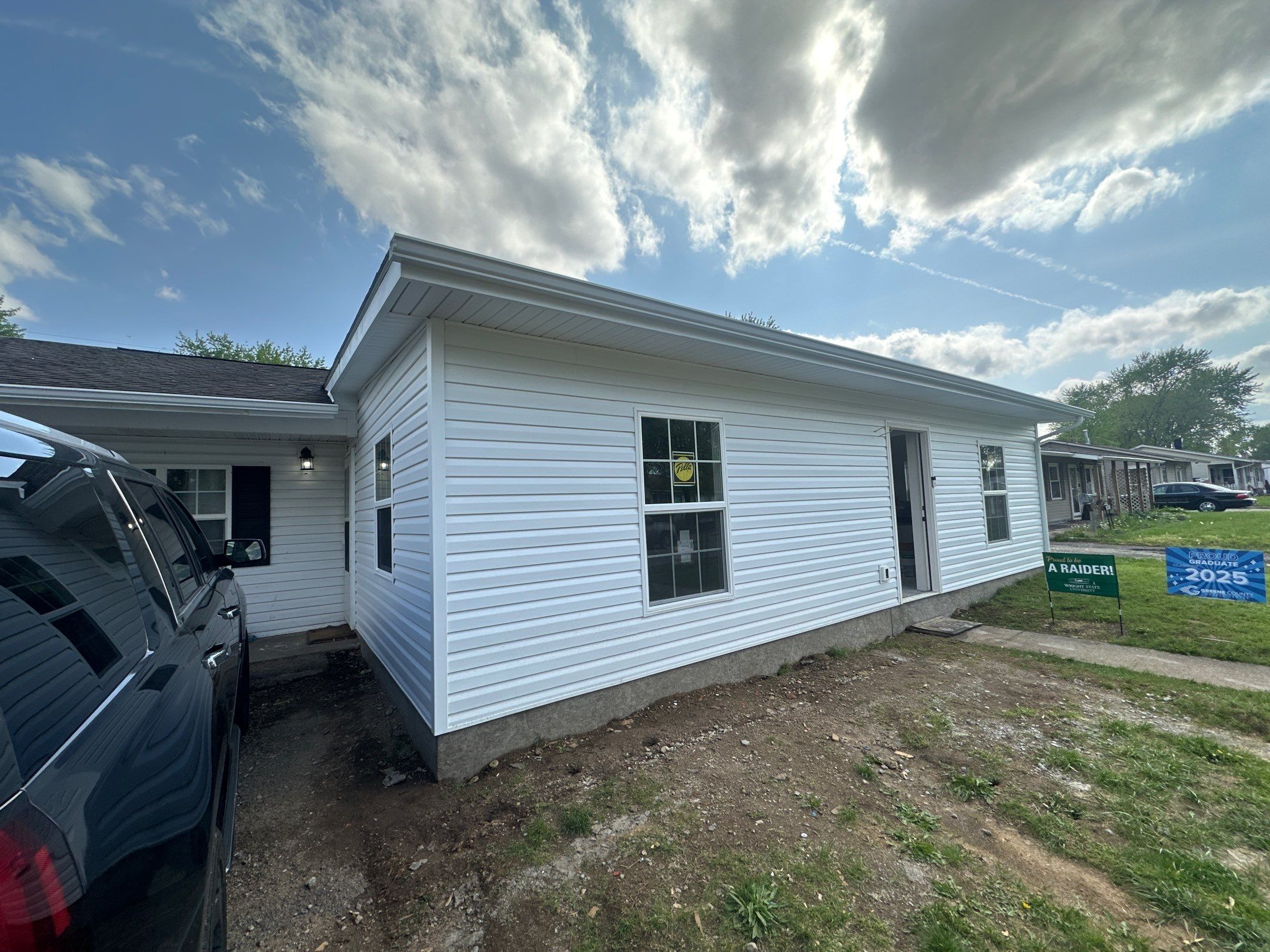
The five project photos trace the full arc — a measuring visit in winter snow confirming the project footprint, fresh wall framing rising with Simpson structural connectors securing every rafter tie, OSB sheathing enclosing the completed structure at dusk, interior drywall and finish work underway with the new black front door already hung, and the completed exterior wearing fresh white vinyl siding and matching windows that make the addition look like it was always part of the home. Thirty days, three rooms, under budget, done right.
What Designing In-House Actually Saves a Homeowner
The typical path to a home addition runs through a separate architect or designer, then a permit office, then a general contractor — each handoff adding time, cost, and communication gaps that inflate both the budget and the schedule. CPM ROOF compressed that entire process by handling the drawings and inspection management internally, eliminating the weeks of lag that outside design professionals introduce and keeping the project moving from concept to permit to construction without waiting on third parties at each phase.
For a homeowner who has worked with CPM for a decade, this in-house capability isn’t a surprise — it’s the reason the relationship has produced $200,000 in completed work across multiple projects. When a contractor can design, permit, and build under one roof, the homeowner pays for the work, not the coordination overhead.
Measuring and Planning the Addition Footprint
The winter site visit photo — measuring wheel in hand, snow on the ground, crew member walking the property in full cold-weather gear — captures the unglamorous first step that every well-executed addition requires. Precise measurements of the existing structure, the lot boundaries, the utility locations, and the foundation conditions inform the drawings that go to the permit office. Getting these measurements right before the drawings are submitted prevents the costly corrections that follow when framing crews arrive and discover the plans don’t match the actual conditions.
This groundwork visit happened in winter conditions that most contractors would use as an excuse to delay. The fact that the tape was out in the snow and the project was moving reflects the attitude that produced a thirty-day build schedule once spring arrived.
Framing Speed Without Framing Shortcuts
The framing photo taken mid-construction shows wall studs running at consistent spacing with Simpson structural connectors securing every rafter-to-wall plate connection visible along the top plate line. These metal connectors — the galvanized brackets visible at each rafter connection in the photo — are the framing detail that separates additions built to code from those built to pass a casual inspection. They transfer lateral and uplift loads from the roof framing into the wall assembly in a way that toe-nailed connections alone cannot match, and their consistent placement across every rafter position in this photo confirms they weren’t treated as optional.
The blue SEI housewrap visible on the existing home behind the new framing confirms the project’s sequencing — new framing rising against a prepared existing wall ready to receive the addition’s integration into the original structure.
Structure Enclosed and Weathertight
The evening photo of the OSB-sheathed addition shows the completed structural shell enclosed before dark — wall sheathing running cleanly to the flat roof deck above, window and door rough openings cut precisely, and safety cones marking the active work perimeter along the sidewalk. At this stage the structure is weathertight enough to protect the interior work from Ohio’s unpredictable spring weather, which means interior trades can begin working simultaneously with the remaining exterior work rather than waiting for full completion above.
The flat roof design visible on the addition integrates cleanly with the existing home’s low-slope ranch profile, keeping the new structure’s massing proportional and architecturally consistent with the original building rather than creating an addition that fights with its host.
Interior Finish Work Running Parallel
The interior photo shows drywall installed, taped, and mudded across the main addition room with crown molding run along the ceiling perimeter — work that was happening while exterior finishing continued outside. The black front door with its half-moon transom window above is already hung and weather-sealed in this photo, and the doorway opening leading into the original home’s interior is framed and ready for trim. A gray accent wall receiving its first coat of paint beside the entry confirms the interior was being finished in stages rather than waiting for every other task to complete first.
Running interior and exterior work simultaneously in this way is what produces thirty-day completion on a three-room addition. It requires a crew large enough and experienced enough to coordinate multiple trades without interference — a project management challenge that a contractor managing their own subs handles better than a homeowner coordinating independently.
GAF Dimensional Shingles Matching the Existing Home
The completed exterior photo shows the addition’s roofline wearing dark dimensional shingles that match the existing home’s roof visible at the left edge of the frame — a continuity detail that makes additions look integrated rather than grafted on. GAF dimensional shingles in the dark charcoal tone installed here provide the shadow depth and multi-tone surface variation that makes a roofline look finished and considered rather than utilitarian. Getting the shingle color to match an existing roof requires sample comparison before ordering — a detail that CPM managed as part of the integrated design and build process.
The soffit, fascia, and gutters running cleanly along the addition’s eave line complete the roofline transition in the finished photo, presenting a continuous, unified eave detail that reads as original construction rather than an afterthought attachment.
White Vinyl Siding That Completes the Transformation
The finished exterior photo tells the thirty-day story in a single image. White vinyl siding covers the addition’s walls in clean horizontal runs that match the existing home’s siding profile, new windows sit in their trimmed openings with black shutters flanking the front-facing unit, and exterior lighting is mounted and operational at the entry. The addition wraps around the front corner of the original home so completely that the transition between old and new construction is imperceptible from the street. A Wright State University graduation sign visible in the yard adds one final detail — this family has something to celebrate, and a home that just got bigger to celebrate it in.
Under $90,000, thirty days, three rooms, and a family relationship that has produced over $200,000 in completed work over a decade. That number reflects something straightforward: when a contractor delivers, homeowners come back.
Design-Build Home Additions by CPM ROOF
Home additions that require separate architects, multiple contractors, and months of coordination before breaking ground don’t have to be the only option. CPM ROOF serves Xenia, OH and the surrounding area with integrated design-build addition services — handling drawings, permits, inspections, and construction under one company and one timeline. For families who want more space without the drawn-out process that most addition projects require, that capability changes the entire experience. Contact CPM ROOF at (937) 860-2925 to start planning your home addition.