



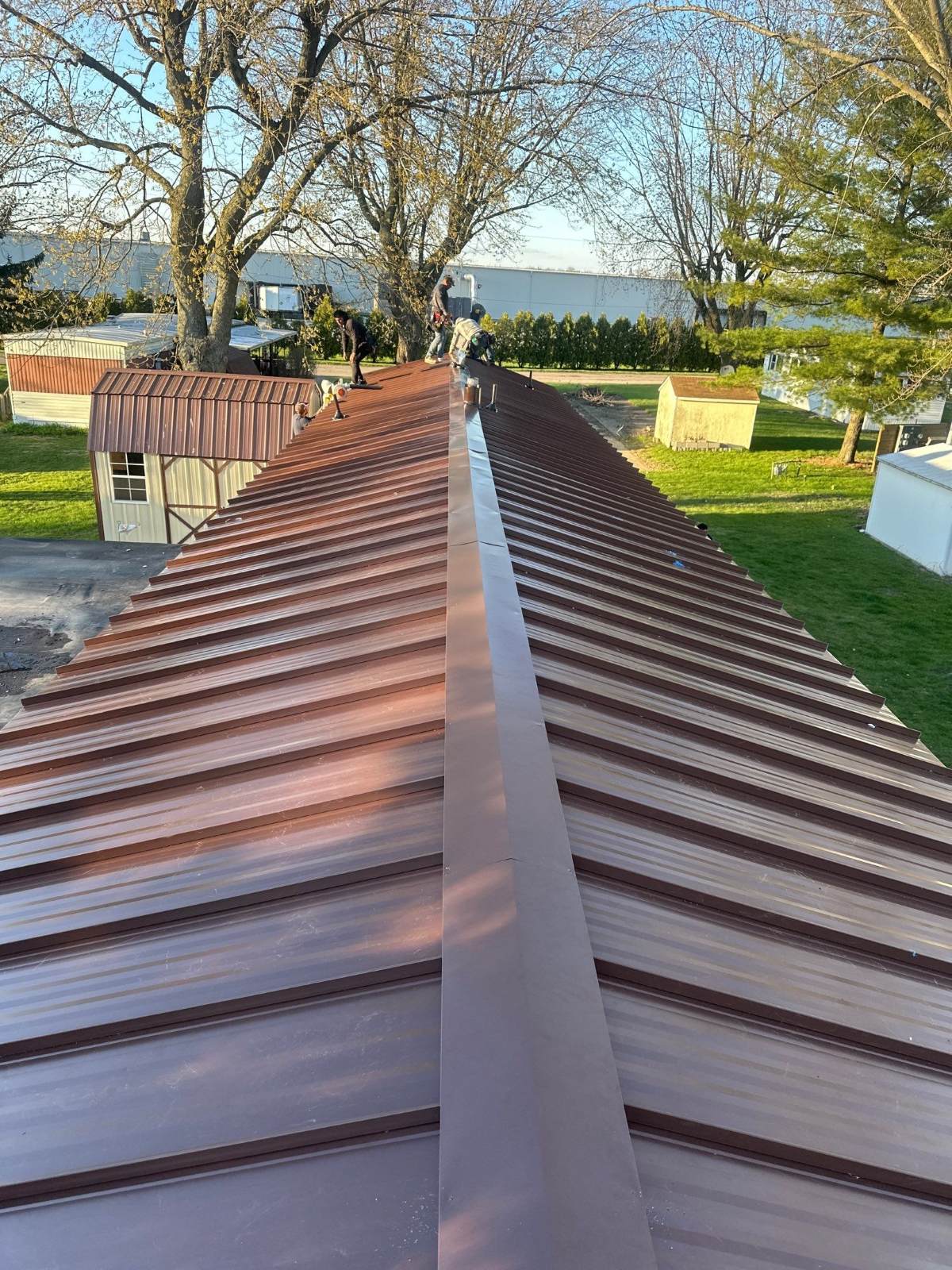

Mobile home roofing is the job most contractors in Sidney, Ohio simply decline — the framing is different, the substrate doesn’t support conventional installation methods, and the liability of doing it wrong on a structure people live in every day makes most companies walk away before the conversation even starts. This homeowner found CPM ROOF through Yelp after striking out locally, and got not just a willing contractor but a thorough one. The original roof had no sheathing underneath — just open metal panels sitting directly on the trailer’s roof framing — which meant the job required opening the existing roof, installing full plywood sheathing across the entire surface, and then laying a Skyline standing seam metal system over a properly prepared substrate. Rich brown panels now run the full length of this single wide, with a clean ridge cap and a finished eave detail that makes this trailer look better than it ever has.
The Problem With Most Mobile Home Roofs
Factory-built single wide trailers were never engineered with the same roofing substrate assumptions that stick-built homes carry. Where a conventional house has plywood or OSB sheathing nailed to dimensional lumber rafters — creating a continuous, fastener-ready surface for whatever roofing product goes on top — many trailer roofs consist of lightweight framing with thin metal panels spanning between members. There’s nothing in between to hold fasteners consistently, distribute load evenly, or provide the flat, rigid surface that a properly installed standing seam metal system requires to perform as designed.
Installing any premium roofing product directly to that framing without addressing the substrate first isn’t a shortcut — it’s a failure waiting to happen at the first wind event or thermal expansion cycle that stresses the connection points.
Opening the Existing Roof
The first phase of this project was demolition of the existing roof surface to expose the underlying framing condition and understand exactly what the new substrate needed to address. Opening a trailer roof that has been in service for years also reveals whatever moisture infiltration history the structure has accumulated — identifying any framing damage that needed correction before plywood went down on top of it. Doing this work on a single wide while the homeowner’s property and belongings remain inside requires careful sequencing and weatherproofing at every stage to prevent interior damage during the transition.
This phase is precisely why most contractors won’t touch mobile home roofing — the unknowns at tear-off on a structure this age create scope risk that contractors without the experience to manage it prefer to avoid entirely.
Full Plywood Sheathing Installation
With the framing exposed and assessed, CPM ROOF installed full plywood sheathing across the entire roof surface — creating the continuous, solid substrate that the Skyline standing seam system required. This step transformed the roof’s structural character from a series of point-load connections at framing members to a fully supported, evenly distributed surface capable of holding the concealed fastener clips that standing seam installation depends on. Plywood sheathing also adds meaningful rigidity to the trailer’s roof assembly, stiffening a structure that factory construction left with more flex than a site-built home would have.
Every sheet of plywood was fastened into the underlying framing members to ensure the sheathing itself was secured properly before the metal system went over it — the foundation that the entire finished installation rests on.
Skyline Standing Seam Panel Installation
The Skyline standing seam system installed over the new plywood substrate features the raised seam profile visible running continuously from eave to ridge on both slopes — panels locked together at their edges through a mechanical seam that keeps all fasteners completely concealed beneath the finished surface. Rich brown panels run the full length of the trailer in consistent vertical lines, with the seam spacing creating a clean, architectural rhythm across both slopes. A matching brown ridge cap seals the peak with a tight, weatherproof termination that completes the system from bottom to top.
Standing seam on a mobile home delivers the same performance advantages it provides on any structure — concealed fasteners with no exposed screws to rust or back out, panel-to-panel connections that accommodate thermal expansion without creating leak points, and a lifespan that far exceeds any shingle product the trailer might otherwise have worn.
H2: The Eave and Trim Detail
The completed street-level view shows the finished eave line running cleanly along the trailer’s roofline with consistent trim detail at the fascia transition. Brown eave trim coordinates with the panel color and provides a finished termination that directs water off the roof edge rather than allowing it to run back under the panel ends. The matching brown window shutters visible on the trailer’s corrugated metal siding work unexpectedly well with the new roof color — a combination that gives this single wide a cohesive, intentional exterior character that most mobile homes simply don’t achieve.
Trim and eave details on a standing seam installation matter as much as the field panels — water management at the eave and rake edges is where improperly finished metal roofs develop their first failures, making clean, tight terminations a quality indicator that’s worth examining on any metal roofing project.
The Job Nobody Else Would Take
There’s something worth noting about a homeowner who calls multiple contractors, gets turned away each time, finds a company on Yelp, and ends up with a result that genuinely exceeds what any of the companies who declined could have delivered. CPM ROOF’s willingness to take on non-standard projects — to open a roof with no sheathing, address the substrate correctly, and install a premium standing seam system on a structure most contractors categorically refuse — reflects a competence and confidence in their own work that standard residential roofing alone doesn’t develop.
This homeowner didn’t just get a new roof. They got the only contractor in Sidney willing to do the job, doing it in a way that will outlast every shingle roof on every stick-built house on their street.
Non-Standard Roofing Solutions by CPM ROOF
Not every roofing project fits the standard playbook — and not every contractor is willing or equipped to handle the ones that don’t. CPM ROOF serves Sidney, OH and the surrounding Dayton area with roofing solutions that go beyond conventional residential work, tackling mobile home installations, substrate corrections, and complex projects that other companies decline. Whether the job requires full sheathing installation before a single panel goes up or creative problem-solving that most contractors aren’t interested in providing, every project gets the same professional execution that turned this single wide into the best-roofed trailer in the neighborhood. Contact CPM ROOF at (937) 860-2925 to discuss your roofing project, whatever it looks like.