




Not every roofing project fits a standard template. Some properties present a combination of building type, roof system, and ownership structure that requires a contractor who can think beyond the typical replacement playbook and deliver a solution that works for the whole picture. A Lebanon property owner came to CPM ROOF with exactly that kind of situation: a unique custom home with a 30-square low-pitch flat rubber roof that had developed leaks in multiple locations — and a business operating in the same structure that made a full tear-off and replacement impractical. CPM solved every problem with a single system: a 15-year Henry silicone coating that sealed the entire roof surface for under $50,000, covering both the residential and commercial sides of the property in one scope.
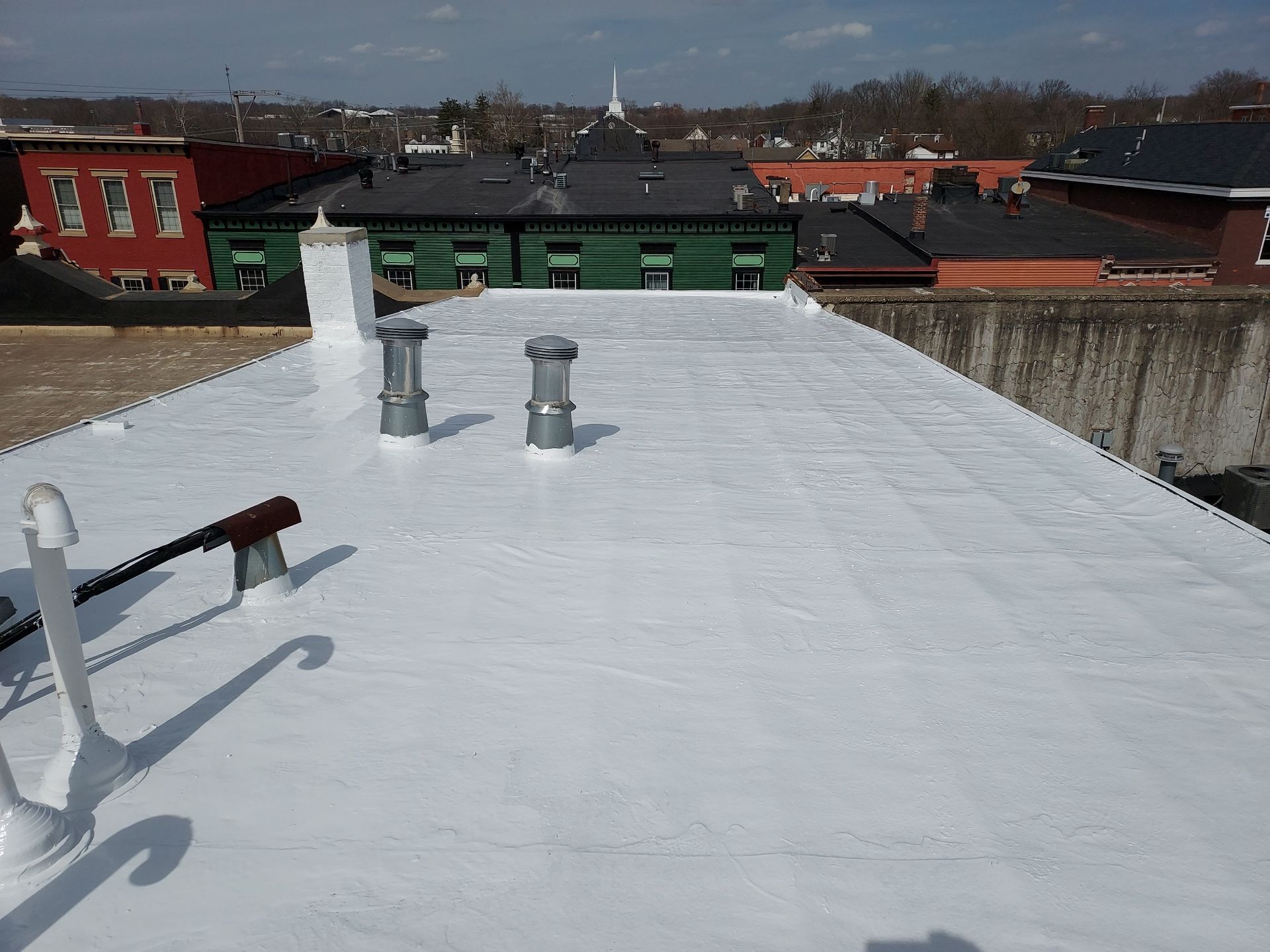
The roof sits atop a multi-story commercial building in a dense downtown block, surrounded by historic brick structures, the East Main Market, and a busy parking area below. Multiple HVAC units, a turbine vent, pipe penetrations, and box gutter infrastructure all had to be properly addressed as part of the coating system. The finished white silicone surface reflects heat, eliminates the active leaks, and delivers a documented 15-year warranty on a roof that had been deteriorating for years.
A Rubber Roof That Had Run Its Course
The existing 30-square rubber roof had reached the point where individual leak repairs were no longer a viable strategy. With leaks occurring in several locations across the field, the membrane had deteriorated broadly enough that patching one area would only redirect water toward the next weakest point. The low-pitch geometry of the roof — which limits drainage speed and increases ponding duration — compounds membrane wear over time, accelerating the deterioration process that eventually led to the active leaks the owner was dealing with.
A full tear-off and replacement on a multi-story commercial building with active business operations below is a significant undertaking in terms of cost, disruption, and logistical complexity. A silicone coating system applied over the existing membrane addressed every leak without requiring any of that disruption — and delivered a longer warranty than a replacement might have.
Why 15-Year Henry Silicone Was the Right Call
Henry commercial silicone applied at the thickness required for a 15-year warranty forms a seamless, self-flashing membrane over the existing rubber surface that permanently flexible, UV-stable, and fully waterproof — including in areas where water ponds after rain events. Unlike acrylic coatings that can re-emulsify in wet conditions or crack under thermal cycling, silicone cures to a rubber-like finish that moves with the building and maintains its waterproofing properties through the full warranty period without recoating.
For a property owner covering both a home and a business under one roof budget, the economics of a 15-year silicone system over a rubber membrane are significantly more favorable than a full replacement — and the performance over that period is fully documented and warranted.
Power Washing and Surface Preparation
Before any silicone was applied, the entire roof surface was thoroughly power washed to remove the oxidation, dirt, and biological growth that accumulates on a rubber membrane over years of exposure. Proper surface prep is the single most important factor in silicone coating adhesion — a coating applied over a dirty or contaminated surface will fail to bond at those areas and allow water infiltration at exactly the points where adhesion was compromised.
On a 30-square commercial roof with multiple HVAC units, a turbine vent, and several pipe penetrations, the prep phase required careful work around every piece of equipment and every penetration to ensure the surface was clean and bondable at the edges and base details that matter most.
HVAC Unit and Equipment Integration
Three HVAC units sit on curbed mounts across the roof surface, each requiring silicone detailing at the curb base where the unit transitions to the roof field. These curb perimeters are among the highest-risk areas on any commercial flat roof — equipment vibration, thermal movement, and water accumulation at curb bases all work against the existing membrane over time, and they’re typically the first places active leaks develop.
Each HVAC curb was coated and detailed with silicone built up in multiple passes to ensure continuous coverage at the base transitions. The turbine vent was similarly sealed at its base flashing to integrate it into the finished coating system rather than leave it as a penetration outside the waterproofing envelope.
Pipe Penetration and Box Gutter Detailing
Multiple pipe penetrations across the roof field — including vent stacks and the box gutter drainage infrastructure along the parapet edge — were each addressed individually before the field coating was completed. Pipe boots and stack bases were coated and built up with silicone to ensure a continuous seal from the membrane surface up the penetration wall, eliminating any gap where water could migrate down the outside of the pipe and into the assembly below.
The box gutters along the parapet edge, which channel water from the roof field to the building’s downspout system, were cleaned and detailed as part of the coating scope. A box gutter that fails to drain properly creates exactly the ponding conditions that accelerate membrane deterioration — getting those drainage paths clean and sealed as part of the overall system was essential to the long-term performance of the finished coating.
The Finished System and 15-Year Warranty
Once the full coating was applied and cured, the roof presented as a uniform bright white silicone surface from edge to edge — every penetration integrated, every curb sealed, every parapet transition coated up the wall face. The white reflective surface reduces the thermal load on the building below compared to the dark rubber membrane it replaced, which contributes to lower cooling costs for both the residential and commercial portions of the property.
The owner covered the full scope — home and business — for under $50,000, with a 15-year warranty backed by Henry’s commercial silicone system. That’s a documented, warranted solution for a property that needed one roof decision to solve every problem across both uses of the building.